Your review, on a schedule. Yours, when it matters.
Turn any completed review into a continuously updated evidence base. Axelium re-runs search, screening, extraction, and risk of bias on the cadence you set, triages newly-found studies in an inbox, and re-pools every monitored outcome through your locked recipe — so you find out the day a pooled estimate moves, not three years later.
A systematic review begun in May 2016 found and synthesised more than 700 papers on Zika virus, but by the time the review came out in January 2017, a further 1,400 papers had been published — and could not be included — making the review outdated before it arrived.
Mortality, 90-day — effect moved
Cycle 7 · 3 new trials · sent to lead reviewerThree new trials added 1,028 patients. The pooled RR shifted 13% and the 95% CI now excludes the null. Locked recipe replayed: random-effects, REML, 90-day timepoint.
Three things have to be true. Axelium does all three.
Catches what actually changed.
Every cycle re-pools each monitored outcome and diffs the result against the prior run. When an effect crosses your alert thresholds — relative change, a confidence interval that flips across the null, a jump in heterogeneity — you get a before/after card with the studies that drove the move.
- Conservative defaults: a 10% delta, a 20-point I² jump, a CI flip across the null, and at least one new contributing trial.
- Symmetric thresholds for ratio measures (RR, OR, HR) — doubling and halving count as equal-size moves.
- Anchored slow-drift detection trips on cumulative shifts that cycle-by-cycle comparisons would miss.
- Captures retractions and re-extractions, not only new trials.
Re-runs your method, not a default.
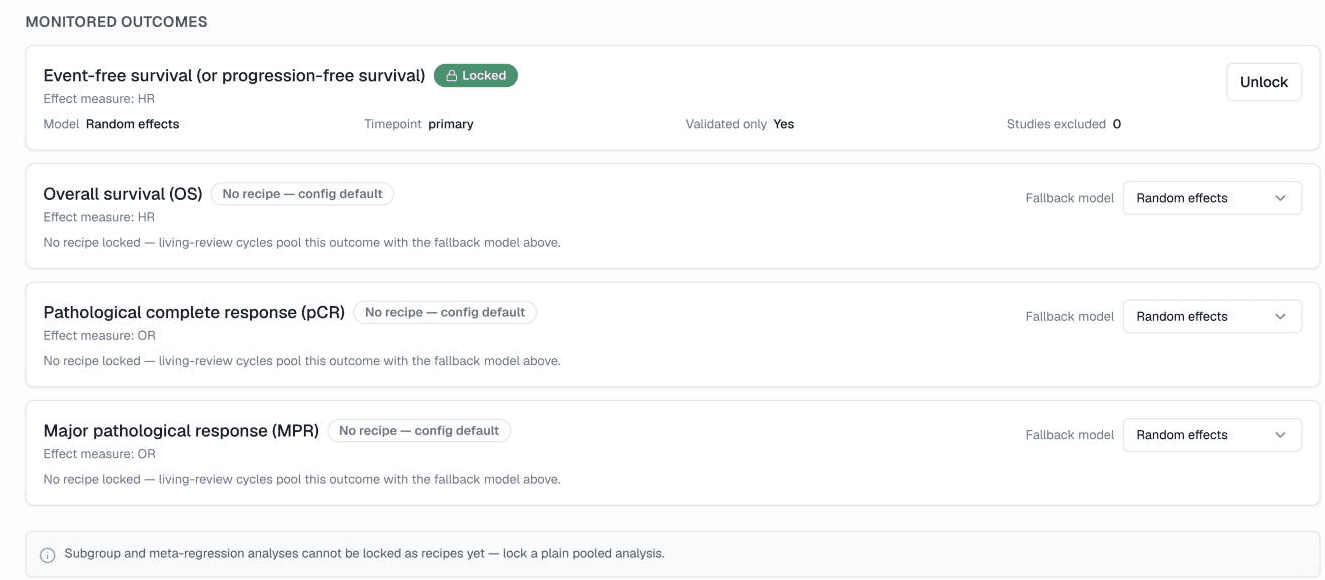
From any completed forest analysis you can lock the exact pooling recipe — model, effect measure, timepoint, and study exclusions — for that outcome. Future cycles replay your decision, so a movement between cycles always reflects new evidence rather than a moved goalpost.
- Recipes are versioned. Re-locking supersedes the previous recipe; the history is preserved for audit.
- Study exclusions are pinned to stable identifiers, so a renamed or re-keyed study can’t silently re-enter the pool.
- Outcomes without a recipe pool with a per-outcome fallback model that you set explicitly.
- A dedicated Recipes page lists every monitored outcome, flags stale recipes, and lets a lead reviewer unlock and re-lock with one click.
Keeps a per-cycle audit trail.
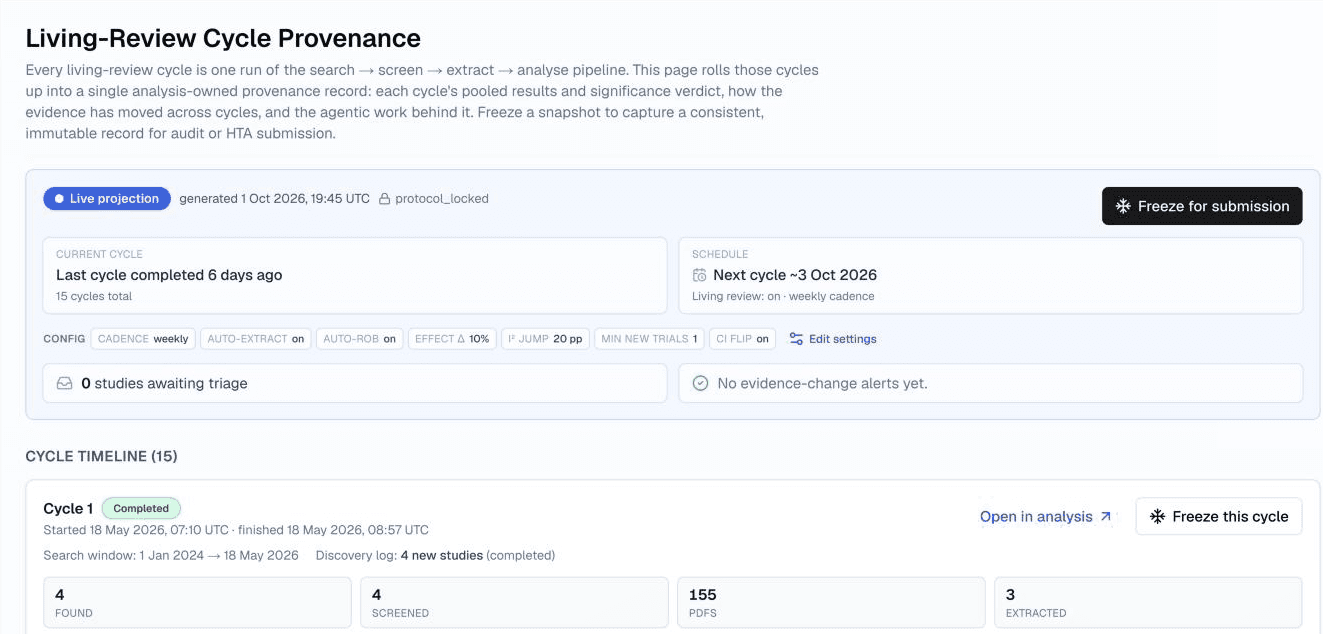
Every cycle keeps its own immutable record — the dates it ran, what changed, what didn’t, and which studies entered or left each pool. “Nothing moved” is a recorded fact, not a gap. The whole timeline can be frozen into a single signed snapshot for an HTA or guideline submission.
- Cycle timeline shows every run with its evidence-change verdict and the studies that contributed.
- Outcome trajectory views show how each pooled estimate evolved across cycles.
- Provenance freeze packages the cycle timeline, outcome trajectories, and frozen analysis snapshots into one downloadable view.
- Same deterministic engine pools each cycle as your interactive analysis — every cross-cycle comparison is apples to apples.
Same pipeline. Replayed on your cadence.
A cycle is the full review pipeline, run again from the question you locked. Nothing is approximated. The output of every cycle is comparable to every other.
- 01On scheduleDaily, weekly, or monthly. Set a maximum studies-per-cycle ceiling and a minimum AI confidence floor so the inbox stays signal-rich.
- 02Re-searchYour full query plan runs across every configured source — the same syntax, the same providers, the same study deduplication as the original review.
- 03Re-screen, re-extract, re-appraiseNew abstracts go through your screening rules; included full texts are extracted with the same form; Cochrane RoB 2.0 runs automatically.
- 04Re-poolEach monitored outcome is pooled through its locked recipe — same engine, same model, same exclusions — and the new estimate is diffed against the prior cycle.
- 05Alert if it movedWhen a pooled result crosses a threshold you set, an alert lands with a before/after table and the studies that drove the change. Otherwise the cycle records “no change” as a verdict.
- 06Triage in the inboxNewly-found studies sit in a Review Inbox. Accept, reject, or mark visible-as-read without forcing a decision. A failure shows the reason in plain language with one-click retry for transient errors.
- Re-ran search · 8 databasesSame query plan as the original review02
- Re-screened, re-extracted, re-appraised3 new trials included03
- Re-pooled through the locked recipeMortality, 90-day04
- Alert sent to lead reviewerPooled result movedRR 0.94 → 0.82
You see it. Not three years later.
Each cycle ends with a verdict — either nothing crossed your thresholds, or the pooled estimate moved. A move surfaces as an evidence-change card on the analysis overview with a before / after table and the studies behind it. From there you can deep-link to the moved outcome in seconds.
- Review Inboxholds newly-found studies for triage — accept, reject, import data, or mark visible as read without forcing a decision.
- Dashboard status chipon every project card shows whether the latest cycle is running, has failed, or is waiting on triage — so leads can see which reviews need attention without opening each one.
- Plain-language failuresshow the reason on the overview, with one-click retry for transient errors — no digging required.
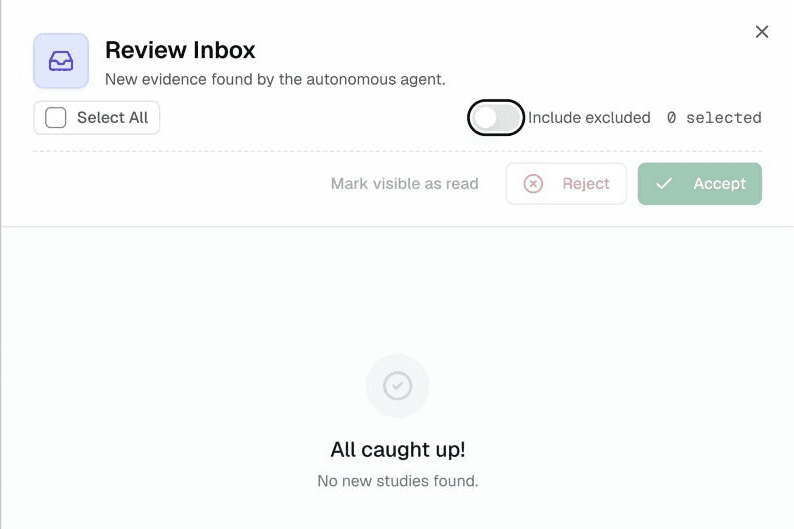
Lock the method. Not the answer.
From any completed forest analysis you can lock the exact pooling recipe — model, effect measure, timepoint, and study exclusions — for that outcome. Every future cycle replays your decision, so any movement reflects new evidence rather than a moved goalpost.
- Recipes are versioned — re-locking supersedes the previous, history preserved.
- Study exclusions are pinned to stable identifiers so a renamed study cannot silently re-enter the pool.
- Outcomes without a recipe pool with a per-outcome fallback model that you set explicitly.
- Stale Recipes panel flags renamed or removed outcomes automatically.
A signed audit trail for every cycle, not just every release.
The Provenance Hub gives every living review its own header at a glance — current cycle status, next scheduled run, your cadence and alert settings, how many new studies await review, and the most recent evidence-change alert. Below it sits the cycle timeline and the frozen snapshots.
The whole timeline can be assembled and frozen into one signed snapshot suitable for an audit trail or an HTA submission. “Nothing moved” is a recorded fact for the cycles where nothing did.
- 01Same deterministic engine for every cycle — apples-to-apples across runs.
- 02AI judges only write the plain-language explanation. Alert firing is decided in code.
- 03Locked recipes are versioned. Every cycle records what it replayed.
- 04Cycle timelines and outcome trajectories freeze into one downloadable snapshot.
Sensible defaults. Configurable thresholds.
Stop restarting reviews from scratch every few years.
Configure a cycle in minutes from any completed analysis — the free tier runs the full review pipeline on one real review end to end, and living-review automation switches on from Professional.